
LNAT Jindal
Aiming for Jindal through the LNAT? Start here.The LNAT is not the CLAT, and it needs different preparation: no legal knowledge, no GK, no maths. It tests how you read an argument. So that is what we teach.
See inside a module
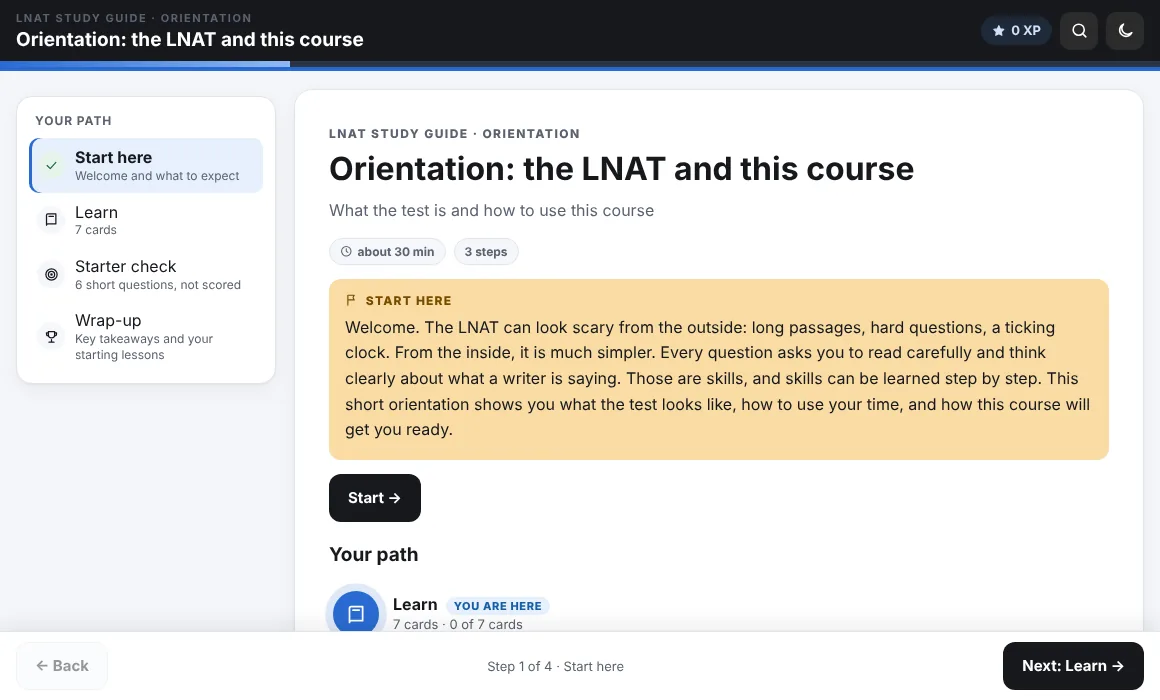 Start here: your path
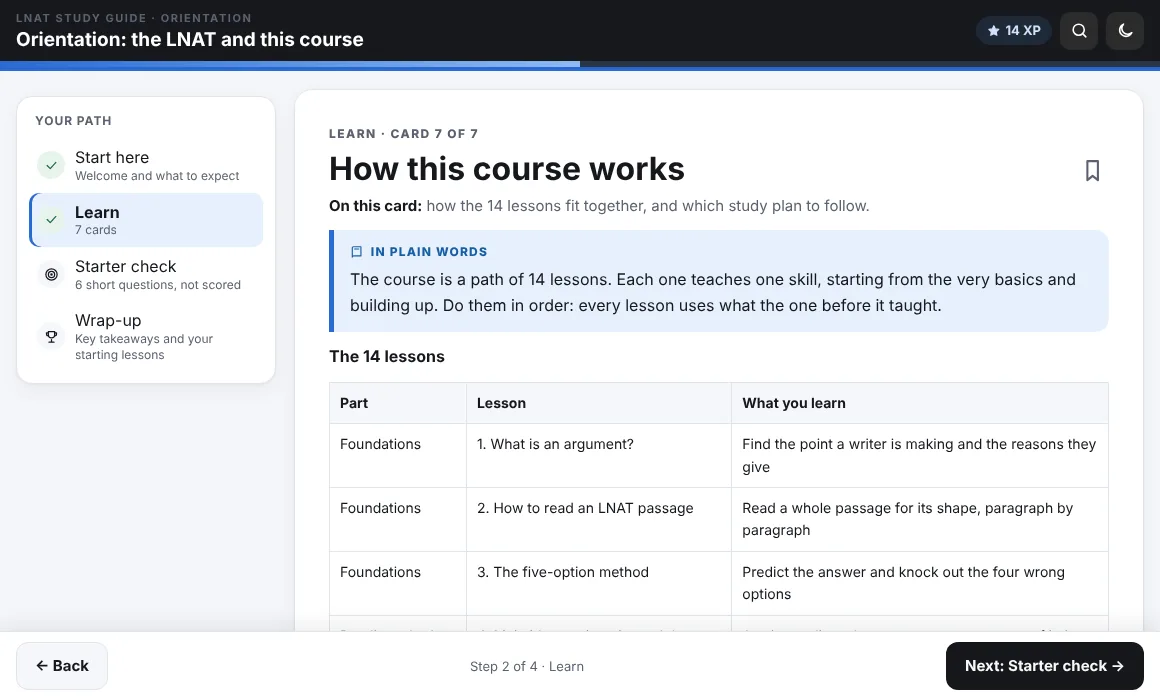 How the course works
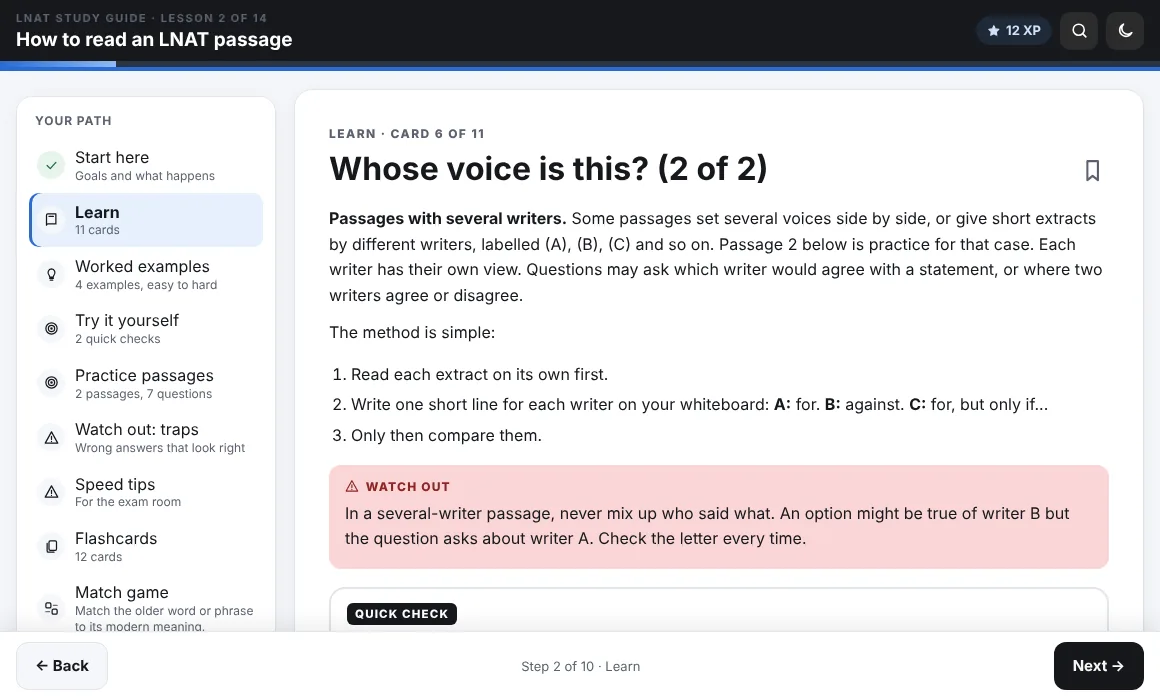 Learn: plain words and watch-outs
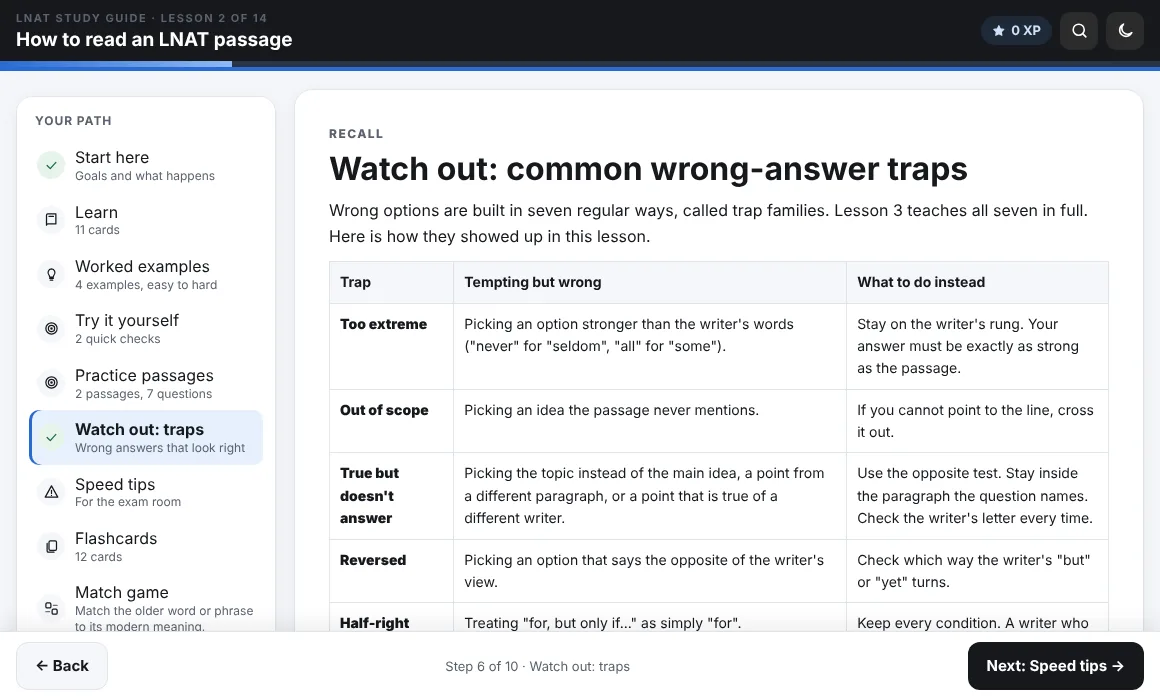 Watch out: the trap families
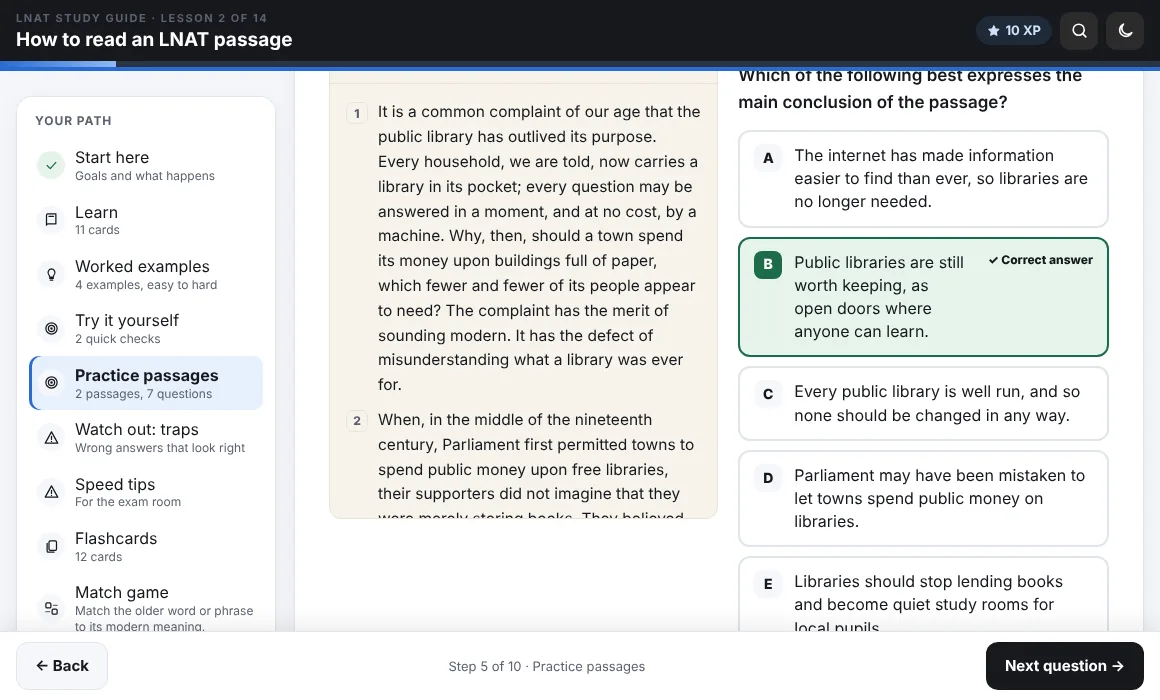 Practice with explanations
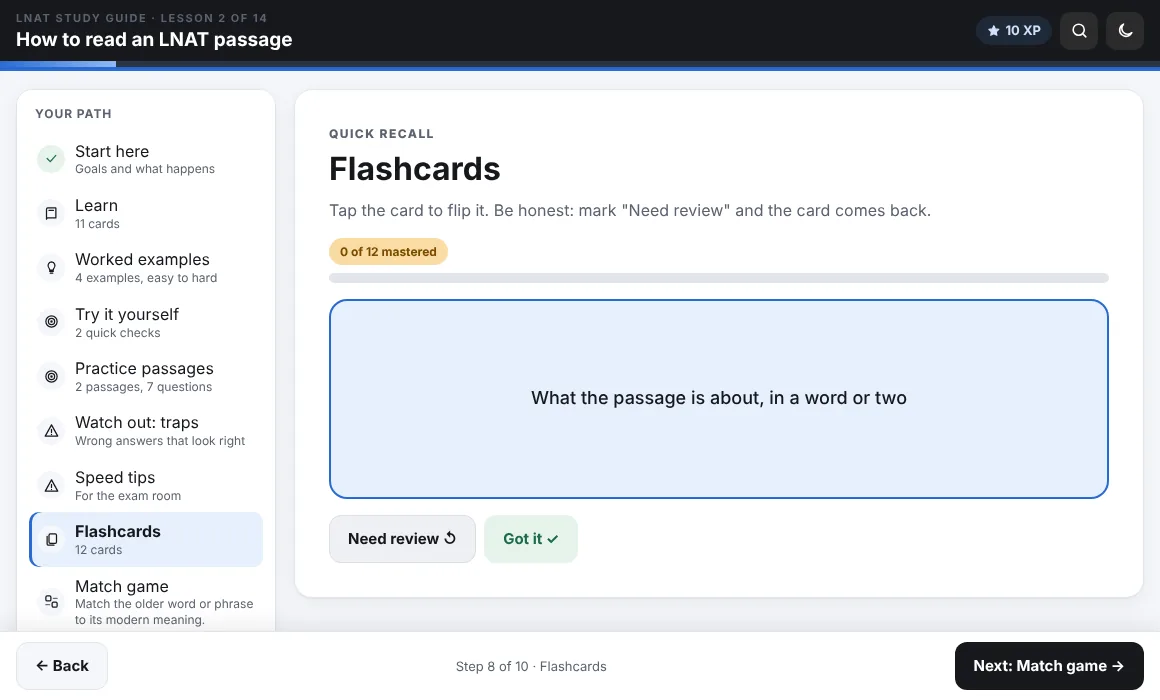 Flashcards
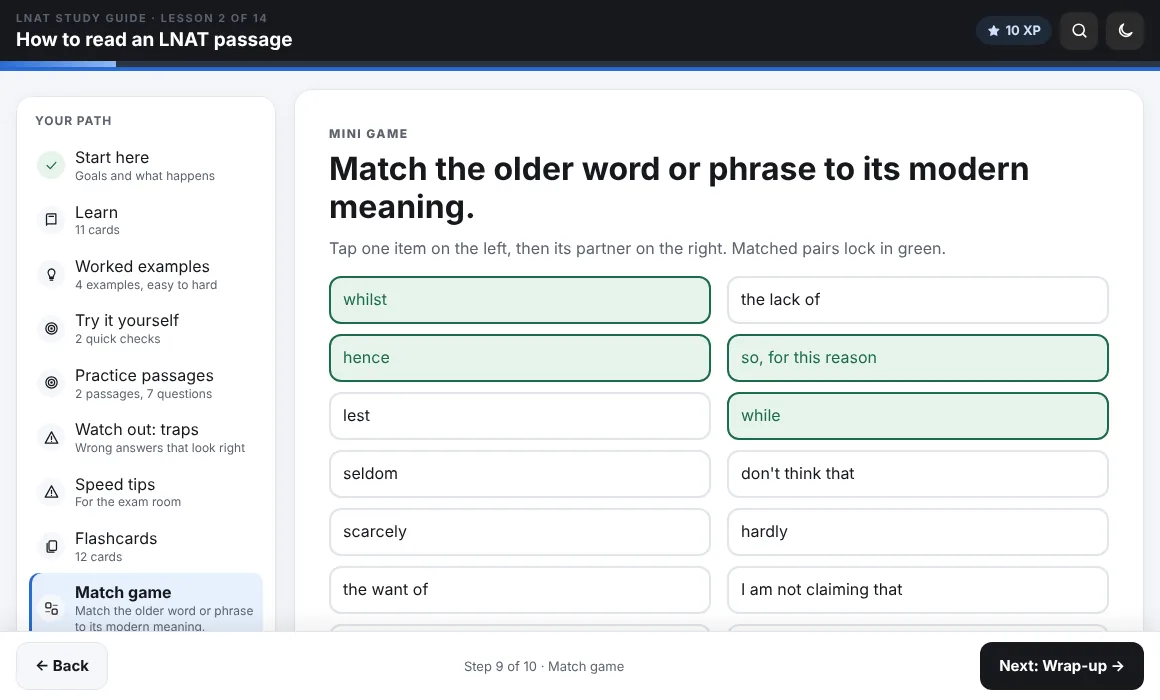 Match game
4 study guides
Short, simple PDFs on the test, the method and your plan. Tap a book to open it.
- Modules Orientation + 14
- Guides 4 study guides
- Support WhatsApp 24×7
1:1 coaching for the LNAT is also available. Message us on WhatsApp .
Orientation and 14 modules
-
What is an argument?
Claim, reasons and conclusion: the building blocks.
-
How to read an LNAT passage
Read for the line of argument, not just the topic.
-
The five-option method
Predict, eliminate in order, never leave a blank.
-
Main idea, main point and the writer's main problem
Tell the topic apart from the point being argued.
-
What the passage says
Questions answered directly from the text.
-
Words and phrases in context
Words used in an unusual sense.
-
The writer's view, tone and several writers
Who thinks what, and how strongly.
-
Inference and implication
What follows, and what only seems to.
-
Applying ideas and analogies
Use the writer's principle on a new case.
-
Why is this here? Function and “because” questions
The job each part of the argument does.
-
Assumptions
What the argument takes for granted.
-
Strengthen, weaken and objections
What helps the argument and what hurts it.
-
Flaws and paradoxes
Where the reasoning breaks.
-
Timed mixed practice
Whole passages at test pace.
What makes us special
One-to-one mentoring
The main focus. Your mentor looks at where you lose marks and works on exactly that.
12 classes, 13 to 28 December
Live and recorded. Short, focused and built around the question types the test uses.
5 full-length mocks
Timed, in the LNAT format, so you practise the pace as well as the questions.
Every answer explained
Each explanation quotes the passage and names the trap in every wrong option.
Study guides
The test, the method and a week-by-week plan, in clean PDFs.
WhatsApp support 24×7
Stuck on a question at midnight? Message us and we will help.
Want 1:1 coaching?
Prefer to learn one-to-one? All the classes are also offered separately as 1:1 coaching. Message us.
1:1 coaching for the LNAT: WhatsApp us →The LNAT is not the CLAT
Many aspirants prepare for it like the CLAT and lose marks. The preparation is different, and so is this course.
CLAT
LNAT
CLAT Knowledge and reasoning across five areas
LNAT Reading and reasoning on an argument
CLAT Current affairs, legal principles and quant are tested
LNAT None needed. The passage is all you use
CLAT Passage-based questions across English, GK, legal, logical and quant
LNAT 42 questions on 12 argumentative passages, then a separate essay
CLAT Marks lost for a wrong answer
LNAT No marks lost, so never leave a blank
CLAT Wide reading, GK and quant practice
LNAT Read closely, spot assumptions, practise at test pace
Test it yourself
Read the short passage, then swipe through four questions. Pick an answer to see why it is right and the trap in every wrong option.
[1] Ask a teenager what they read in English last year and you will hear fragments: a chapter, two pages of a speech, a few poems. Each was chosen with care, yet many pupils cannot say how any book ended, because they were never asked to finish one.
[2] The defence is breadth: twenty writers teach more about literature than one. There is something in this. Variety can spark an interest that one long novel might smother.
[3] But a whole book asks something an extract cannot: that the reader hold a long argument in mind and stay with it through the slow parts. That is a skill, and like any skill it is learned only by doing it. A pupil who has tasted twenty dishes has not thereby learned to cook one.
[4] Schools should therefore put the complete book, read from first page to last, back at the centre of English teaching. Extracts have their place, as a taster. They should not be the meal.
Which of the following best expresses the writer's main conclusion?
In paragraph 3, the writer says “A pupil who has tasted twenty dishes has not thereby learned to cook one” in order to:
The writer's argument depends on which of the following assumptions?
Which of the following, if true, would most weaken the writer's argument?
Original practice questions by Lawnchpad. They are not official LNAT questions. Every question in the course is explained this way.
The test in numbers
Your Section A mark out of 42 is your LNAT score. The test also has a separate essay (40 minutes, one of three questions), which is not counted in that score. Source: lnat.ac.uk, checked 6 Nov 2026.
How Jindal uses your score
The course runs from 13 to 28 December, so you can sit the test after it and still be inside the window.
JGLS dates and cut-off are from news reports of its 2027 announcement (read 5 Nov 2026). The cut-off is reported, not promised: JGLS sets it each year. Check lawadmissions.jgu.edu.in before you book.
Specially curated for
Jindal aspirants
Who need a strong Section A score and want a clear plan to get there.
CLAT aspirants adding the LNAT
Who know the LNAT needs a different kind of preparation.
Students who want a mentor
Who learn faster with personal feedback than on their own.
Questions
Is the LNAT the same as the CLAT?
No. The CLAT tests knowledge and reasoning across several areas. The LNAT tests how you read and reason about an argument, with no legal knowledge, GK or maths. That is why the preparation is different.
Do I need to know any law?
No. Everything you need is in the passage. The course teaches you how to read it, predict, and cross out the wrong options.
What do I get?
12 classes (live and recorded) from 13 to 28 December, 5 full-length mocks, an Orientation and 14 interactive modules, study guides, one-to-one mentoring and WhatsApp support 24×7.
Are the classes live or recorded?
Both. The 12 classes run live from 13 to 28 December, and recordings are available too.
What is 1:1 coaching and how do I get it?
It is the same classes taught one-to-one, just for you, offered separately from the course. Message us on WhatsApp and we will tell you how it works and the fee.
Is there negative marking?
No. No marks are lost for a wrong answer in Section A, so you should never leave a blank.
Can I prepare for the CLAT and the LNAT together?
You can, but they need different preparation, so plan time for each. Message us on WhatsApp and we will help you plan.
Can I use it on my phone?
Yes. The modules work on phone and desktop, in light or dark mode, and save your progress.
I have a question before buying.
Message us on WhatsApp and we will help.

 200K+ creators trust Graphy